The Period of the Moon Continues Without a Course
Lecture 8: The Phases of the Moon
Key Ideas:
The Moon always keeps the same face towards the Earth.- Rotation and Revolution are synchronous .
- Fraction of the sunlit side visible to us.
- Lunar Sidereal Period: 27.3 days
- Lunar Synodic Period: 29.5 days
Our Nearest Celestial Neighbor
The Moon is a natural satellite of the Earth.Its orbit around the Earth is elliptical :
- ~0.15% out of circular.
- Tilted by 5° from the Ecliptic.
- Mean Distance: 384,400 km
- Perigee (Closest Approach): 363,300 km
- Apogee (Maximum Distance): 405,500 km
- Appears ~11% larger at Perigee than at Apogee
Synchronous Rotation
The Moon's rotation period is equal to its orbital period:- The Moon completes 1 rotation about its axis in the same time as it completes 1 orbit around the Earth.
As a consequence, the Moon always keeps the same face towards the Earth.
- Near Side: hemisphere facing towards the Earth
- Far Side: hemisphere facing away from the Earth
The synchronization of the Moon's rotation and orbit is caused by strong tidal forces from the Earth that effectively "locks" the Moon's orientation relative to the Earth.
[Note: The degree of synchronization is not perfect for two reasons. First, the Moon's orbit is elliptical rather than circular, so that the Moon's orbital speed is faster at perigee and slower at apogee. This mis-match in the exact orbital and rotation rates results in an apparent east-west "rocking" motion of the Moon by about 7.9 degress over the course of a month. The second is that the axis of the moon's rotation is tilted by about 7 degrees relative to its orbital plane (like the Earth's 23.5 degrees). This leads to an additional north-south nodding motion over the course of a month. The combined rocking and nodding motion motion is called "libration". You can see libration in the lunation movie below.]
Phases of the Moon
The Moon produces no visible light of its own- It shines only by reflected sunlight
- Surface is very dark, only ~7% reflective
During the month, we see a complete cycle of Phases :
- The sunward hemisphere is fully lit.
- The opposite hemisphere is dark.
The phase of the Moon depends on the fraction of the sunlit hemisphere visible to us.
-
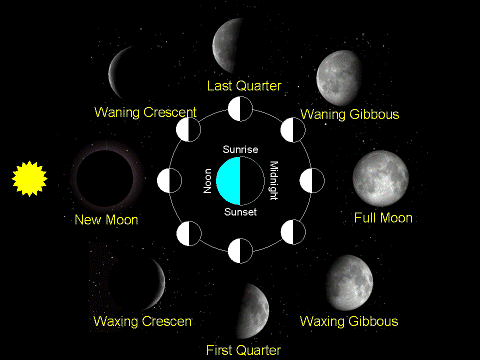
- Graphical depiction of the phases (click to see full-size)
New Moon & Full Moon
New Moon:- Moon and Sun are on the same side of the sky.
- Near side is in total darkness.
- Moon and Sun rise together.
Full Moon:
- Moon is opposite the Sun in the sky.
- The near side is fully illuminated.
- Moon rises as the Sun is setting.
Quarter Moon
Quarter Moons occur when the Earth, Moon, & Sun are at right angles:- Half of the near side is illuminated
- Half of the far side is illuminated
First Quarter:
- Quarter Moon between New Moon and Full Moon.
Last Quarter:
- Quarter Moon between Full Moon and New Moon.
- Sometimes also called "Third Quarter"
With New Moon and Full Moon, they help to divide the Lunar Month into quarters.
Waxing & Waning
Waxing: increasing illumination- Waxing Crescent: just after New Moon
- Waxing Gibbous: just before Full Moon
Waning: decreasing illumination
- Waning Gibbous: just after Full Moon
- Waning Crescent: just before New Moon
Moonrise, Moonset...
You don't see all moon phases at all times- Never see a crescent moon at midnight.
- Never see the last quarter moon at sunset.
- Never see a full moon during the day.
Times of rising and setting depend on the details of the Earth-Sun-Moon configuration as viewed from the surface of the rotating Earth.
Moonrise and Moonset during Full Moon:
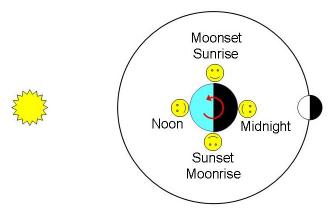
(Click on the image to view at full scale [Size: 28Kb])
- Full Moon rises as the Sun sets.
- The Full Moon is in mid-sky at Midnight.
- Full Moon sets as the Sun rises.
- Full Moon cannot be seen during the day.
The View from the Moon
Question: What would an astronaut on the Lunar near side see during one month?Answer:
- See the Earth neither rise nor set, but stay nearly fixed at the same position in the sky.
- See the Earth rotate on its axis once every 24h.
- See the Earth go through phases.
Lunar Sidereal Period
The Lunar Sidereal Period is the time it takes the Moon to complete one orbit around the Earth with respect to the stars.- Moon's Sidereal period = 27.3 days
- Also called the "Sidereal Month"
The Sidereal Period of the moon is measured watching its motions against the background stars:
-
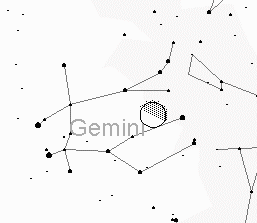
The Moon on 1999 Oct 2: Last Quarter Moon in Gemini -
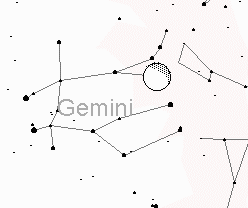
27.3 days later on 1999 Oct 29: Waning Gibbous Moon in Gemini
Note: The background constellation is the same 27 days later (Gemini), but the Moon is in a different, earlier phase (Waning Gibbous, which comes before Last Quarter phase).
Lunar Synodic Period
The Lunar Synodic Period is the time between successive New Moons.- Moon's Synodic period = 29.5 days
- Also called the "Synodic Month"
This is the month used by Lunar Calendars:
- The Islamic calendar starts and ends on the New Moon, signaled by the first appearance of the Waxing Crescent moon.
Why are they different?
While the Moon orbits the Earth, the Earth orbits the Sun.- Start at New Moon: Sun-Moon-Earth aligned.
- It takes the Moon 27.3 days to complete 1 orbit around Earth with respect to the stars.
- In the meantime, the Earth has moved through 27.3 days of its orbit (about 27deg along its orbit).
- The Moon & Earth must move together for an extra 2.2 days to re-align with the Sun.
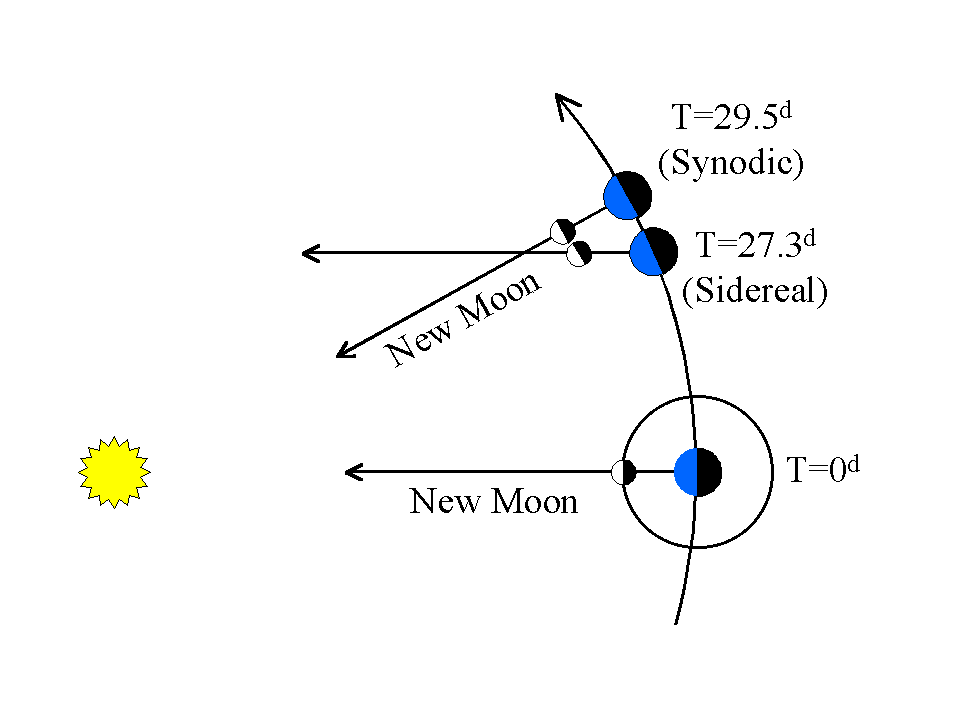
(Click on the image to view at full scale [Size: 9Kb])
A Note on Terminology:
Sidereal is derived from the Latin word for star (sidus). A Sidereal Period denotes the time it takes for an object (for example, the Moon) to return to the same place as seen with respect to the stars.
Synodic is derived from the Greek word synodos, meaning a "coming together" (e.g., a Church "Synod"). The Synodic Period of the Moon is therefore the time between the apparent coming together of the Sun and Moon on the same side of the sky at successive New Moons.
Synodic periods always require you to combine two Sidereal periods. In this case, we are combining the orbit of the Moon around the Earth (the Moon's Sidereal Period), and the Earth's orbit around the Sun (the Earth's Sidereal Period) together to compute the Synodic Period.
Return to [ Unit 2 Index | Astronomy 161 Main Page ]
Updated: 2008 January 21
Copyright © Richard W. Pogge, All Rights Reserved.
Source: https://www.astronomy.ohio-state.edu/pogge.1/Ast161/Unit2/phases.html

Post a Comment for "The Period of the Moon Continues Without a Course"